By Sara Khalid, Greennex Global Editor | April 2026
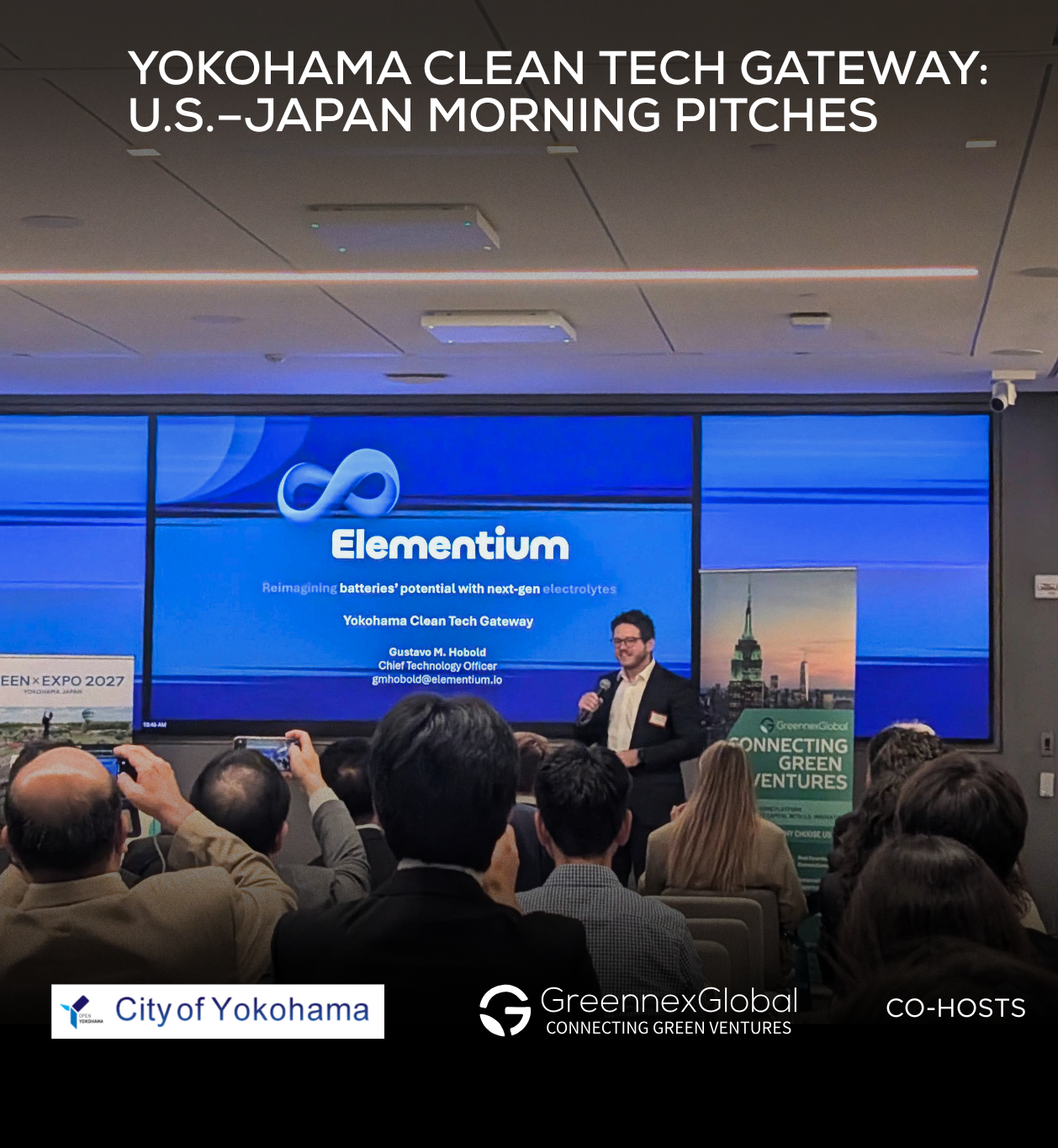
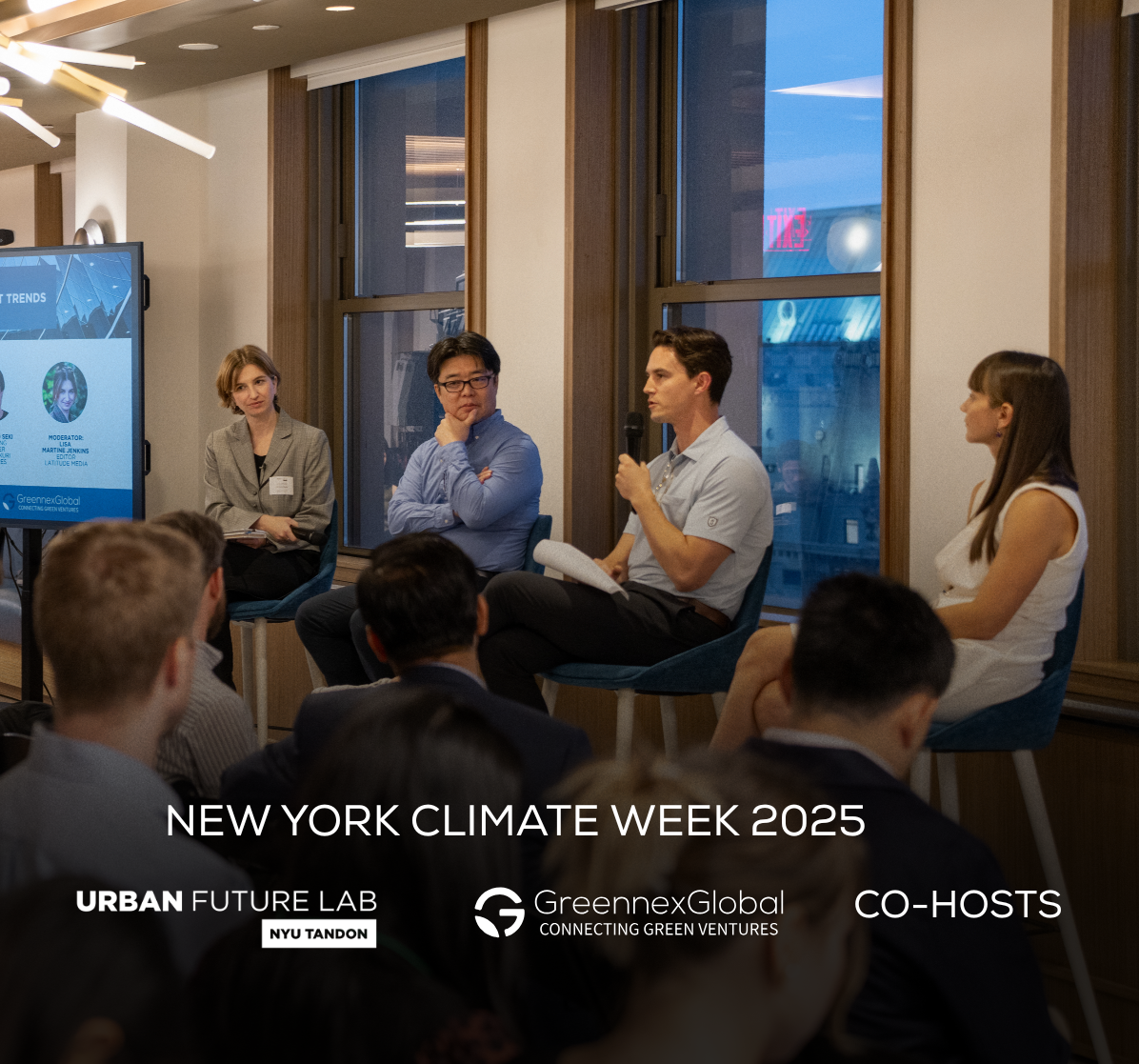
Greennex Global, in partnership with the Urban Future Lab at NYU Tandon School of Engineering, launched the Global Founder Studio, a concept where corporates reverse pitch to our curated startups. Our first event focused on AI and Energy, and senior operators from three of Japan’s largest energy and industrial platforms presented their challenges, technology priorities, and partnership pathways, followed by breakout rooms for direct conversations on technology fit, pilot potential, and deployment pathways.
The session brought together Junya Saka of Mitsubishi Electric’s ME Innovation Fund, Shigeki Uchihashi of JERA Americas, and Hirotaka Mori of ENEOS Americas. Junya Saka captured why the format works from the corporate side: “From a corporate investor’s perspective, having the opportunity to directly promote our areas of interest and CVC philosophy to multiple startups is extremely valuable. The program design, with themes narrowed down in advance, made discussions easier and allowed us to efficiently reach the right startups.”
Leveraging the institution’s over a decade of experience in supporting best-in-class climatetech startups with a 93% company survival rate, Frederic Clerc, Managing Director of the Urban Future Lab, set the context for why this collaboration matters: “We strongly believe in the importance of collaboration between disruptive technologies and incumbent industries, especially when it comes to scaling and de-risking the path to commercialization of your innovations.” He noted that access to cross-border capital is particularly difficult for climate tech right now, and that the partnership with Greennex Global is strategic precisely because it opens new sources of capital for companies navigating that gap.
Three Leading Japanese Corporates Take the Stage
Senior operators from three of Japan’s most influential energy and industrial platforms stepped in front of a room of U.S. climatetech founders — not to evaluate, but to pitch. Each shared where their organization is headed, what technology gaps they are trying to close, and what a real partnership pathway looks like from their side of the table.
Mitsubishi Electric Innovation Fund

Junya Saka outlined the fund’s focus on converging the physical and digital worlds — combining Mitsubishi Electric’s industrial assets across energy infrastructure, factory automation, and the built environment with AI-enabled, data-driven services. Launched in 2022 with approximately $40 million in partnership with Global Brain, the fund invests up to $3 million per company at pre-Seed through Series A, with pilot integration preceding every investment decision.
JERA Americas
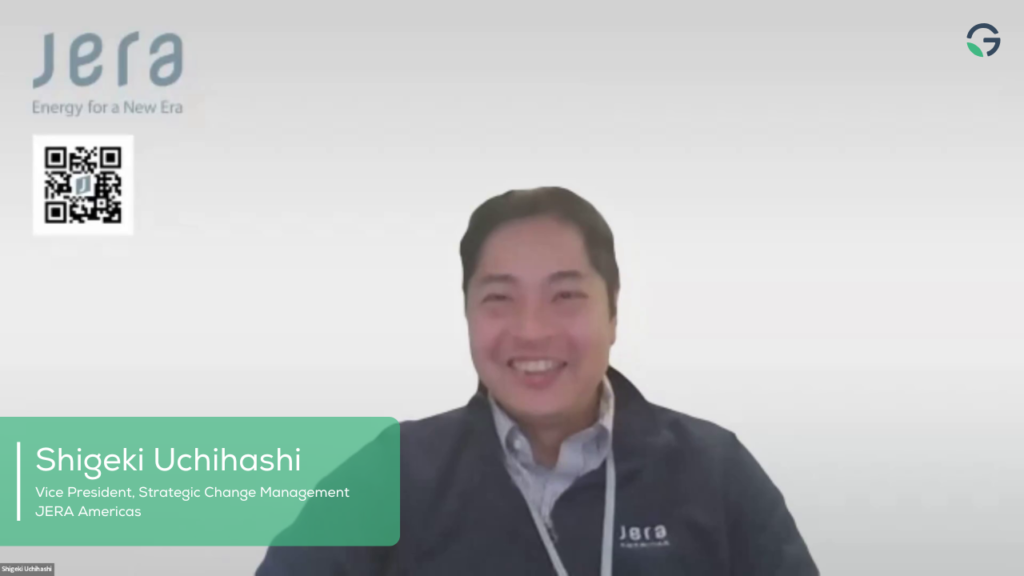
Shigeki Uchihashi introduced JERA — formed from the carve-out of power generation assets from TEPCO and Chubu Electric Power — as a company with ambitions to become a truly global energy firm spanning LNG, renewables, hydrogen, and fuel trading. JERA Americas manages roughly ten thermal generation assets across the Northeast U.S., serving as a testbed for technologies that, once validated at smaller scale in the U.S., can be deployed across JERA’s broader portfolio in Japan and South Asia. JERA Ventures, with a $300 million fund, is actively investing at the intersection of decarbonization and AI-driven energy optimization.
ENEOS Americas
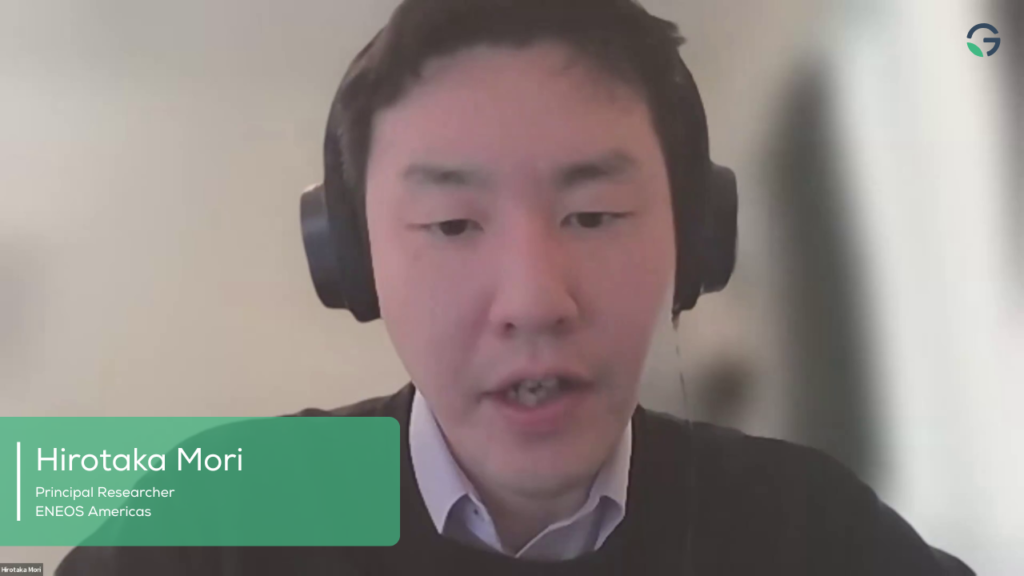
Hirotaka Mori described ENEOS as one of Japan’s largest energy and materials companies — holding approximately 50% of Japan’s domestic fuel oil market, operating nine refineries and 12,000 gas stations nationally — that is actively transitioning toward hydrogen, renewables, CCUS, synthetic fuels, and circular materials. Its CVC arm holds over 40 portfolio companies globally, with eleven in North America, investing at Seed through Series B with ticket sizes of $1 to $3 million. Data center cooling is a current priority, where ENEOS is seeking startup partners to leverage its proprietary expertise in lubricants and thermal fluids.
The Cohort: Startups at the Table
The sixteen startups selected for the first Global Founder Studio represented some of the most technically rigorous and commercially advanced U.S. climatetech companies working at the intersection of AI, energy, and infrastructure, which were pre-screened by Greennex Global and the Urban Future Lab for technology readiness and fit with the corporate priorities on the day.
The cohort spanned:
- Grid Intelligence and AI forecasting: Grid8, Amperon, ThreeV, Qubit Engineering, CFEX
- Energy Storage and Battery Materials: florrent, Bridge Green Upcycle, Nascent Materials)
- Carbon Capture: CarbonQuest, Mitico
- Geothermal and Fusion Energy: Bedrock Energy, Realta Fusion
Decentralized Water and Cooling Infrastructure: Nona Technologies, Aequor
Across the room, the common thread was commercial traction paired with genuine technical depth — exactly the profile the Japanese corporate partners had come looking for.
Inside the Breakout Rooms
Following the reverse pitches, founders moved into curated breakout sessions for direct conversation with each corporate team. The format was intentional: rather than open networking, each room was structured around a specific corporate partner, giving founders the focused context needed to move past introductory discussion and into substantive questions about technology fit, pilot structure, and what a real next step might look like from both sides.
The conversations that followed reflected that design. Founders came in having already heard each corporate’s priorities and mandates — which meant the breakout time could go directly to the specifics: whether a given technology mapped onto an active procurement need, what a pilot might require operationally, and where decision-making authority actually sits within each organization. For the corporate teams, it was an efficient way to have multiple high-quality conversations in a compressed format, with founders who had already been pre-screened for relevance.
Saka noted what distinguished the format from a standard pitch event: “It was refreshing that the format wasn’t a one-way pitch; the breakout sessions enabled true two-way communication. I also felt the quality of the startups was excellent. Even for early-stage companies, the fact that they had already been screened by Greennex and Urban Future Lab gave me confidence in their caliber.”
That pre-screening matters. The startups in the room weren’t there by open registration — they had been selected based on technology readiness, commercial traction, and fit with the specific priorities each corporate had shared in advance. That alignment between what corporates were looking for and who was in the room is what made the breakout conversations productive rather than exploratory.
What Global Founder Studio Is Built For
Stella Song, Founder of Greennex Global, closed the session by acknowledging what the format had produced: “It’s productive, and exactly what we’re designed here to be — real conversations, real decision makers, really high impact, and real opportunities.”
For U.S. climate tech founders, the path to global scale rarely comes from a cold introduction. It comes from being in the right room, with the right operators, at the right stage of commercial readiness. What the first Global Founder Studio demonstrated is that when that access is structured — when corporates share their mandates openly and founders come prepared — the conversations that follow move faster and go further. The goal was never exposure. It was connection: founders finding real commercial partners, and corporates finding technologies they can actually deploy.
What’s Next
The Yokohama Climate Tech Gateway Program continues throughout 2026, connecting U.S. East Coast climate tech startups with Japanese investors and corporations through year-long community engagement, with in-person events during New York Tech Week (June 1st) and Climate Week NYC (September 25th).
For startups building climate infrastructure solutions with demonstrated U.S. commercial traction and readiness for international deployment, this is where strategic capital and cross-border partnerships converge.
Startups: Apply to pitch at Greennex Climate Gateway Investors: Contact us at info@greennexglobal.com
Greennex Global is a cross-border market intelligence and dealflow platform focused on climate infrastructure. Greennex Climate Gateway is our flagship government-backed program connecting U.S. climate tech startups with international deployment infrastructure and strategic capital.
The Urban Future Lab at NYU Tandon School of Engineering is the longest-running climate tech incubator in New York — home to ACRE, the Carbon to Value Initiative, the Offshore Wind Innovation Hub, and the Innovate UK Global Incubator Program — and has supported companies that have collectively raised over $3.9 billion in venture capital, project finance, and grants while creating 5,000+ jobs.