Scaling Climate Innovation From a Small Market Requires Thinking Borderless
For climate startups, international expansion is often framed as an ambition reserved for later stages, after product-market fit and Series A. But for founders operating in smaller markets like Switzerland, global thinking is almost a starting condition.
With a highly technical workforce, world-class infrastructure, and a small domestic consumer base, the country has long produced companies that look outward early. And increasingly, Switzerland is also positioning itself as a magnet for foreign startups and companies looking for a stable European base.
Lisette Muery, Trade Commissioner for Foreign Direct Investment at the Swiss Business Hub in New York, sits at the center of this cross-border dynamic. As part of the federal agency Switzerland Global Enterprise, Muery both promotes Switzerland as a business location and supports Swiss companies entering international markets.
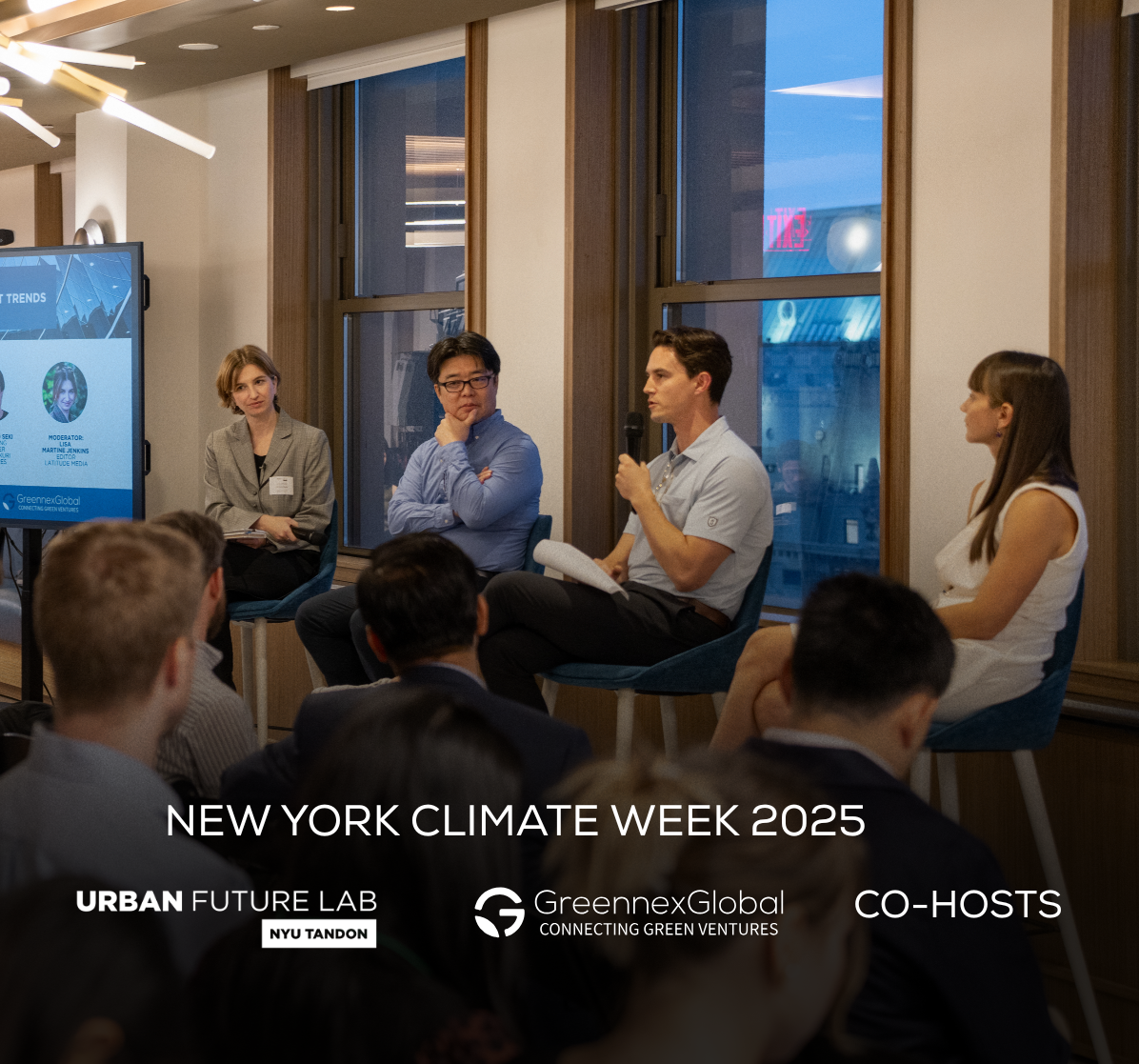
At the Global Venture Dialogue during New York Climate Week, Greennex Global and Urban Future Lab sat down with Muery to discuss why international collaboration can be a startup’s most strategic asset, and what founders often misunderstand about Switzerland as a landing spot.
International Collaboration Isn’t Optional When Your Domestic Market Is Small
For Swiss startups, scaling often requires early exposure to international customers. But beyond market access, Muery emphasizes that cross-border experience builds a deeper competitive trait: adaptability. “It’s always good to learn different regulatory frameworks,” she says, “so startups can adapt with their products.”
This is where institutions like the Swiss Business Hub play a catalytic role. They function less like a traditional government office and more like an operational bridge, helping founders enter the U.S. market with local knowledge and network access.
Why Switzerland Is an Underrated Landing Spot for Founders
When founders imagine global expansion, they often default to the biggest destinations: the U.S., the EU, or fast-growing Asian markets. Switzerland is rarely the first place that comes to mind. Yet for companies building technical teams, Switzerland competes less on headline market size and more on what founders feel every day: the ability to hire well. “I think access to talent is one of our biggest selling points,” she explains. Further, the country offers a “high quality of life, stable economy, stable currency, and political stability,” she says, along with central access to Europe and strong infrastructure.
Even outside the EU, Switzerland remains deeply integrated into the European economy. “We have a lot of bilateral trade agreements with all countries around us,” Muery notes, which makes it easier for companies to treat Switzerland as a hub rather than a standalone endpoint.
What Founders Get Wrong About Expanding to Switzerland
Despite Switzerland’s global reputation, Muery says founders tend to carry two misconceptions: language and cost.
Language is often the first worry. Switzerland has four national languages, but that complexity paradoxically makes English the common denominator. “Because we have so many different languages,” she says, “the language that everybody speaks is English… English is really not a problem.”
Cost is the second concern. Switzerland is perceived as expensive, and salaries are high. But Muery argues the full equation is often misunderstood. “If you set up in Switzerland, you may pay higher salaries,” she says, “but compared to other European countries, you have much less overhead with social contributions.” She also notes that labor-market flexibility can be greater than in other European jurisdictions, which affects long-term operating costs.
The result is a counterintuitive reality: Switzerland can be “expensive” in appearance, yet cost-effective in execution.
Climate Messaging Is Shifting, Even When the Work Stays the Same
In the panel discussion, Muery was asked about whether recent political rhetoric—especially skepticism toward climate policy—has changed how people talk about the U.S. market.
Her answer was precise: the underlying initiatives are continuing, but the language around them is evolving.
She described attending a sustainability-focused reception at the Swiss ambassador’s residence, where a government-backed platform was introduced to help SMEs and startups become more sustainable—specifically by reducing the friction of figuring out where and how to act. “Oftentimes they just don’t have the time to actually do this,” she noted, which is why the platform exists: to help companies identify concrete areas to improve.
But what stood out was the conversation afterward. Muery observed that many actors aren’t abandoning climate efforts—they’re reframing them. “They’re not changing the program,” she said. “They’re not really changing anything. They’re just using different words.”
For climate startups, this is a strategic lesson: resilience isn’t just technical. It’s rhetorical. In volatile political environments, the ability to communicate impact in the language of the moment can determine whether momentum survives.
The Main Takeaway: Switzerland’s Advantage Is Structural, Not Just Geographic
Muery’s perspective reframes how founders should think about international growth. Expansion is not just about entering a larger market. It is about building an operating system that can survive complexity.
For Swiss startups, global scaling is inevitable because the domestic market demands it. But the deeper lesson is universal: international collaboration builds adaptability, regulatory literacy, and cultural fluency—traits that matter as much as technology itself.
And Switzerland, often overlooked in the founder’s imagination, offers something rare: a stable base with world-class talent and European access, paired with institutional support that helps companies bridge the gap between ecosystems.
In an era where climate innovation must move fast across borders, Switzerland is not just a small country with strong infrastructure. It is a strategic platform for building globally deployable solutions—quietly, efficiently, and at scale.
*
This conversation was produced by Urban Future Lab and Greennex Global, a New York–based investment advisory and innovation intelligence platform connecting global smart infrastructure and next-generation energy ventures.