When the “Climate” Label Becomes a Strategic Choice
In climate tech, language is rarely neutral. The way a company describes itself can shape everything from investor interest to customer adoption, particularly in a moment when political rhetoric around climate has become increasingly polarized.
For Jonathan Healy, Vice President at Cathay Innovation, this creates a nuanced tension. The technologies being built across energy, mobility, manufacturing, and supply chains are essential to decarbonization. Yet the label “climate” does not always help them scale.
Cathay Innovation, a global multi-stage investment firm operating across venture and private equity, deploys capital at the intersection of physical and digital transformation, spanning sectors from energy and mobility to manufacturing and supply chains. Within this, Healy focuses on technologies that modernize legacy systems, particularly where software can unlock efficiency and scale in capital-intensive infrastructure.
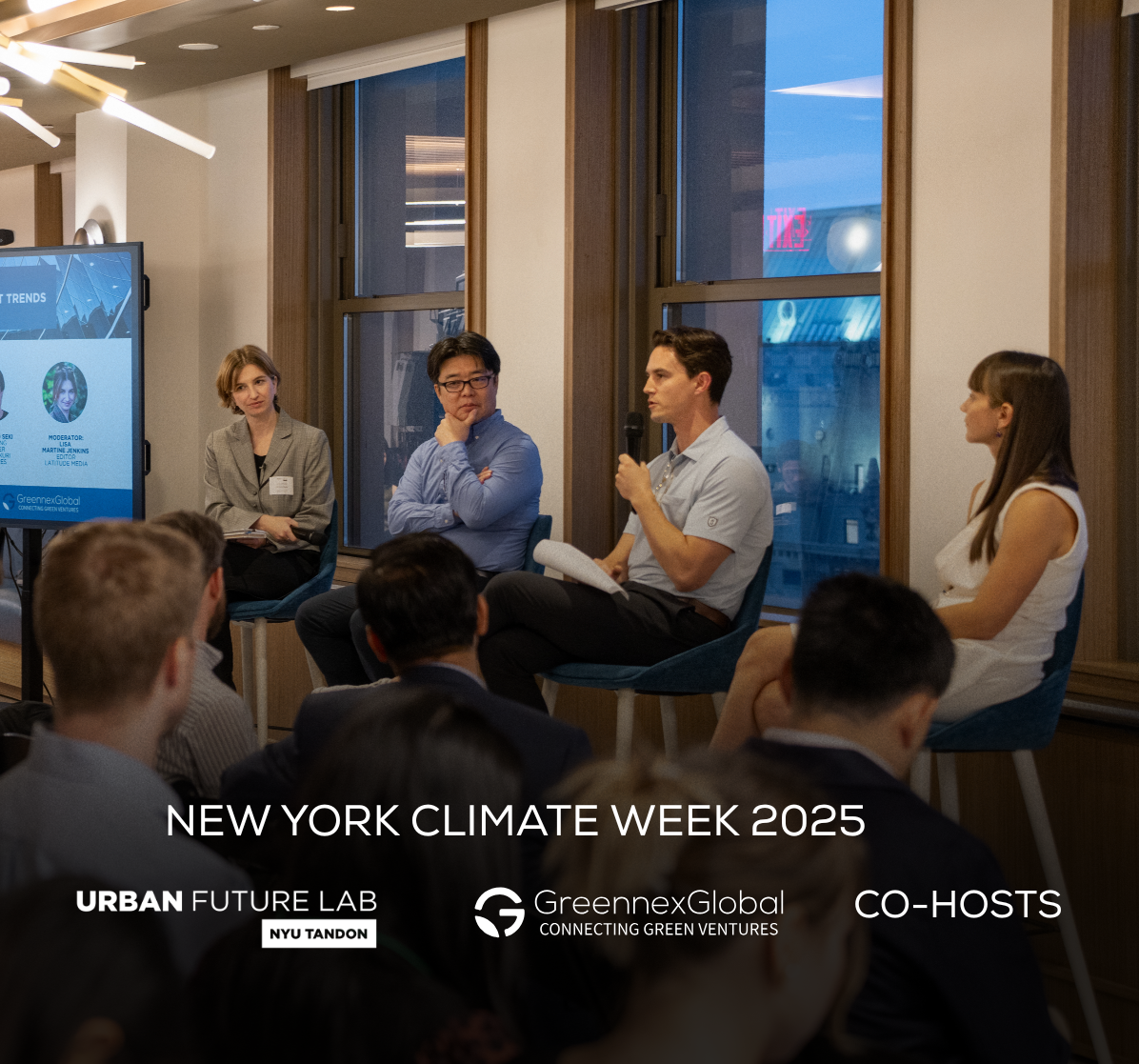
At the Global Venture Dialogue (GVD) convening two panels of global investors, Greennex Global and Urban Future Lab hosted Healy to discuss how climate branding can influence access to capital, and how rising energy demand, talent flows, and fragmented global systems are redefining scale, all while venture capital continues to pursue one constant: economic return.
The Investor Mandate: Returns First, Everything Else Second
This reframing aligns closely with the fundamental structure of venture capital itself.
At Cathay Innovation, Healy’s role is straightforward: generate returns. That mandate cuts across sectors, whether the underlying technology sits in AI, healthcare, or energy systems.
“We want to materially improve the world and generate economic returns in doing so,” he notes, “but, at the end of the day I am on the hook to return our LP’s capital.”
This does not mean climate outcomes are irrelevant. Rather, they are embedded within a broader economic calculus. A company succeeds not because it is labeled climate, but because it solves a real problem, generates revenue, and scales within its market.
In that sense, the most investable climate technologies are often those that do not rely on benevolent climate outcomes alone as their primary justification. They stand on their own economics, and the impact follows.
Energy and Water: A New Infrastructure Reality
Even though messaging may be shifting, the underlying systems are becoming more and more important to address. For the first time in decades, energy demand in the United States is rising in a meaningful way, driven largely by data centers and the expansion of digital infrastructure. What had long been a slow-moving sector has struck “a pain point” now, as Healy puts it.
He also points to a striking projection: by 2030, data center energy consumption could rival that of water desalination in the U.S. The comparison is telling because it highlights how unevenly attention is distributed across infrastructure challenges.
While AI dominates headlines, adjacent systems such as water, grid flexibility, and distributed energy networks remain comparatively under-discussed, despite being equally critical to long-term capacity.
This is where opportunity emerges. Not in isolated technologies, but in the intersections where digital tools can optimize physical systems, and where rising demand exposes inefficiencies that can no longer be ignored.
Global Scaling Is Not Plug-and-Play
Despite the global nature of climate challenges, scaling solutions remains deeply regional.
Technologies that succeed in one geography often require significant adaptation elsewhere, shaped by differences in infrastructure, policy, and capital availability. “There isn’t one model,” Healy explains. “You have to understand the system you’re operating in.”
Australia’s lead in battery deployment, for instance, reflects both necessity and cultural preferences around energy independence, while Europe’s fragmented regulatory landscape demands more localized approaches to scaling. In the United States, a mix of federal incentives and state-level complexity creates yet another distinct environment.
For Healy, this variability is not a barrier so much as a structural reality. Founders who assume that success in one market can be directly replicated in another often underestimate the importance of local context, particularly when it comes to financing structures and regulatory alignment.
Talent Flows as the Hidden Consequence
For Healy, the most immediate consequence of shifting political discourse is not a change in technology, but a change in who is willing to work on it, and where.
“Everything is determined by talent inflows and outflows,” Healy notes, “and my biggest worry is that it drives away talent.”
In a sector where many builders are motivated, at least in part, by climate impact, rhetoric that dismisses or politicizes the space can have a chilling effect. Domestically, it risks narrowing the pool of people who see climate as a viable or valued area to work in. Internationally, it can discourage founders and engineers from engaging with U.S. markets altogether, particularly when combined with immigration constraints and broader geopolitical tensions.
Not All Capital Is the Same
A common assumption in climate tech is that venture capital is the default pathway to scale. “Venture gets over-glamorized,” Healy says. “It’s not meant as the primary source of funding across all stages for most of these technologies.”
Especially with climate technologies involving hardware or infrastructure, investment requires longer timelines and different risk profiles than traditional venture models are designed to accommodate.
Healy is clear about where Cathay sits within this spectrum. The firm focuses on commercially viable opportunities that can scale within a venture framework, rather than early-stage scientific or regulatory bets that may take decades to mature.
For founders, this distinction is critical. Choosing the wrong type of capital can constrain growth as much as, if not more than, choosing the wrong market.
Examples like Northvolt underscore this point. Even with strong execution, success ultimately depends on whether the surrounding financial ecosystem is capable of supporting the scale required.
The Main Takeaway: Scale Comes from Economics, Not Framing
Across the conversation, a consistent principle emerges: climate technologies do not scale because of how they are labeled, but because of how they perform.
In a politically charged environment, messaging can either accelerate or hinder a company’s trajectory, shaping how it is perceived by investors, customers, and partners. Founders who recognize this are increasingly deliberate in how they position their work, emphasizing economic value over categorical alignment.
But beneath that strategic framing, the fundamentals remain unchanged.
Capital flows toward returns. Talent flows toward opportunity. And technologies that solve real, system-level constraints will scale, whether or not they are described as “climate.”
*
This conversation was produced by Urban Future Lab and Greennex Global, a New York–based investment advisory and innovation intelligence platform connecting global smart-infrastructure and next-generation energy ventures.